
Table of Contents
Background of the SEE Exam
The results of Annual SEE Exam, 2080 has been published on 27th June, 2024. The SEE exam, formerly known as the School Leaving Certificate (SLC) exam, is a critical assessment for Grade 10 students in Nepal. It serves as a gateway to higher education and vocational training opportunities. Since its inception, the SEE has been a benchmark for evaluating the academic proficiency of students nationwide.
How to check SEE Results 2080 with Marksheet ?
Students can check their SEE results via official websites, SMS, and IVR services once the National Examination Board (NEB) publishes them. 186 students have achieved GPA 4 score.
Check SEE Results 2080 via Websites
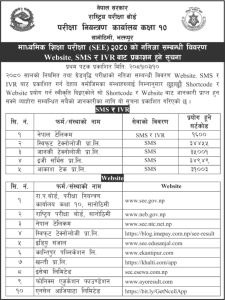
You can also check your SEE results online by visiting the following websites:
- NEB, Examination Control Office Class 10 – Website: www.see.gov.np
- National Examination Board (NEB)- Website: www.neb.gov.np
- Nepal Telecom – Website: www.see.ntc.net.np
- IMEpay – Website: https://blog.imepay.com.np/see-result
- Kantipur Publications – Website: https://results.ekantipur.com/see-results-with-marksheet.php
- Esewa Limited – Website: see.esewa.com.np
- Ayo Result – Website: www.ayoresult.com
- EduSAnjal – Website: https://see.edusanjal.com
Details of the 2080 SEE Exam
This year’s SEE exam was held over a span of 16 days, from Chaitra 15 to 27, 2080(March 25th to April 9th, 2024). A total of 500,000 students participated, including 250,772 female students, 253,627 male students, and 15 students from sexual and gender minority groups. These students hailed from 10,806 public and private schools, and the exam was conducted in 2,064 centers across the country.
Expected Date for Result Publication
The NEB has announced that the SEE results will be published by June 28, 2024. However, they have also indicated that if the pending work is completed ahead of schedule, the results might be released earlier. This announcement has brought a mix of relief and anxiety to students and parents alike.
Impact of Early Result Publication
Publishing the SEE results earlier than expected has several benefits. It allows students to plan their next steps in education or career paths more effectively. Schools and colleges can also streamline their admission processes, reducing the waiting time for students. Overall, it enhances the efficiency of the entire education system.
Reaction from Students and Parents
The anticipation of SEE results often brings a blend of excitement and nervousness. Students are eager to see the fruits of their hard work, while parents hope for the best outcomes for their children. In this period, counseling and support systems play a vital role in helping students cope with anxiety and prepare for their future endeavors.
Future Prospects for SEE Graduates
For SEE graduates, the future holds numerous opportunities. Higher education institutions, including colleges and universities, open their doors for further studies. Vocational training programs provide alternative pathways for those interested in skill-based careers. The SEE results are a stepping stone towards diverse career prospects and personal growth.
FAQs
1. What is the SEE exam?
The SEE exam, or Secondary Education Examination, is a national-level assessment for Grade 10 students in Nepal, serving as a gateway to higher education and vocational training.
2. How many students took the SEE exam in 2024?
In 2024, over 500,000 students took the SEE exam, including 250,772 female students, 253,627 male students, and 15 students from sexual and gender minority groups.
3. When will the SEE results be published?
The SEE results are expected to be published by June 28, 2024. If the pending work is completed earlier, the results may be published sooner.
4. What are the challenges in publishing the SEE results?
Challenges in publishing the SEE results include logistical issues, ensuring fairness and security, handling a large number of candidates, and the meticulous process of marking and result compilation.
5. What are the future prospects for SEE graduates?
SEE graduates have various opportunities, including higher education in colleges and universities, vocational training programs, and diverse career prospects.