
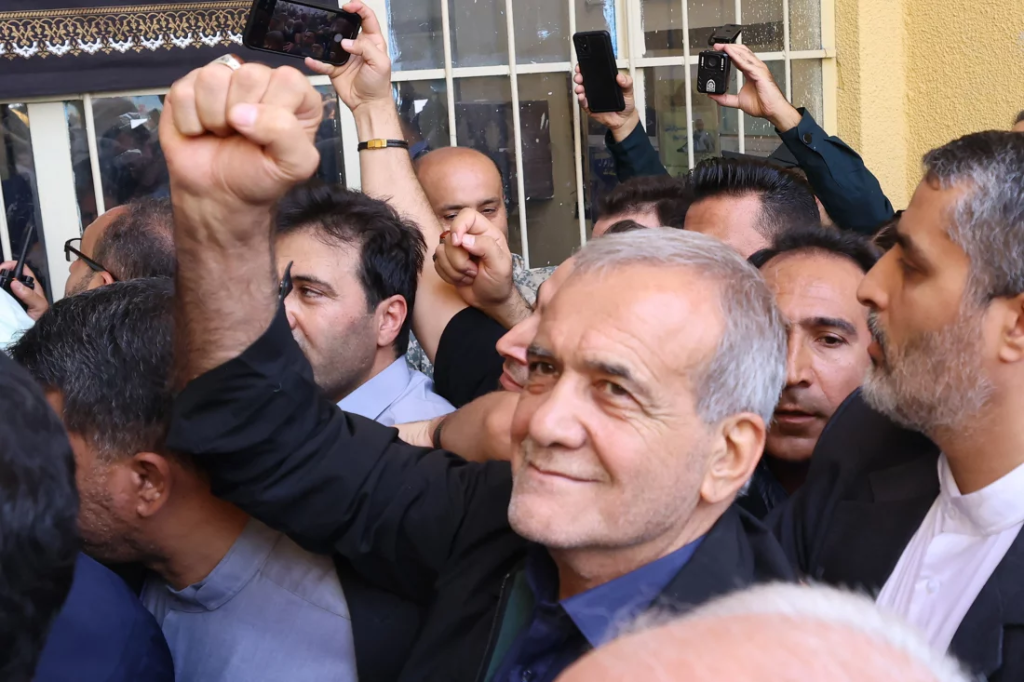
Iranian voters have decisively chosen reformist candidate Masoud Pezeshkian in the runoff election to succeed late President Ebrahim Raisi, who died in a helicopter crash in May.
Iran’s president-elect Pezeshkian, a heart surgeon and lawmaker who ran on a moderately reformist platform, was relatively unknown. However, voter turnout increased from the first round, giving him over 2.8 million votes more than hard-line conservative Saeed Jalili, a former nuclear negotiator with strong anti-Western views.
Approximately 30 million people, or about 49.6% of eligible voters, participated in Friday’s election, which is considered low for presidential elections. Pezeshkian received 16.3 million votes compared to Jalili’s 13.5 million, according to officials.
Pezeshkian promised to engage more with the international community and is expected to appoint moderate cabinet ministers. However, his proposals are modest, and he is unlikely to push for significant changes in a government where all important matters are controlled by Supreme Leader Ayatollah Ali Khamenei.
He will also contend with a government still largely dominated by hard-liners amid ongoing tensions with the West over various issues, including the war in Gaza.
Election process
Snap elections were called after President Raisi’s death in a helicopter crash on May 19.
The Guardian Council, responsible for vetting candidates, narrowed a long list of hopefuls to six: five hard-line conservatives and one reformist. Two candidates dropped out before the first vote.
The first round of presidential elections was held on June 28 among the remaining four candidates: Pezeshkian, Jalili, parliament speaker and former Tehran mayor Mohammad Bagher Qalibaf, and Mostafa Pourmohammadi, a Shia cleric who served in Iran’s Interior and Intelligence Ministries.
No candidate received a majority, with Pezeshkian leading with 10.4 million votes and Jalili trailing with 9.4 million. They advanced to Friday’s runoff.
This runoff was only the second in the country’s history, with the first occurring in 2005 when hard-liner Mahmoud Ahmadinejad won against former President Akbar Hashemi Rafsanjani.
Persistent low turnout
Iran has faced low voter turnout for years. The first round of the presidential election saw a record low with only 40% of eligible voters casting ballots.
Turnout was slightly higher in the runoff, but still, more than half of eligible voters did not vote, indicating a preference for the reformist candidate but also widespread apathy.
Dissatisfaction with the Islamic Republic and skepticism about the effectiveness of presidential elections in enacting significant change contributed to the low turnout.
Pezeshkian voiced support for new social reforms, such as reducing the presence of the morality police, but many are skeptical of his effectiveness. According to Sanam Vakil, director of the Middle East and North Africa program at Chatham House, “It’s very unclear if he will be able to push them through and effect a change, ultimately since the Iranian president on his own doesn’t have that much independent autonomy.”